
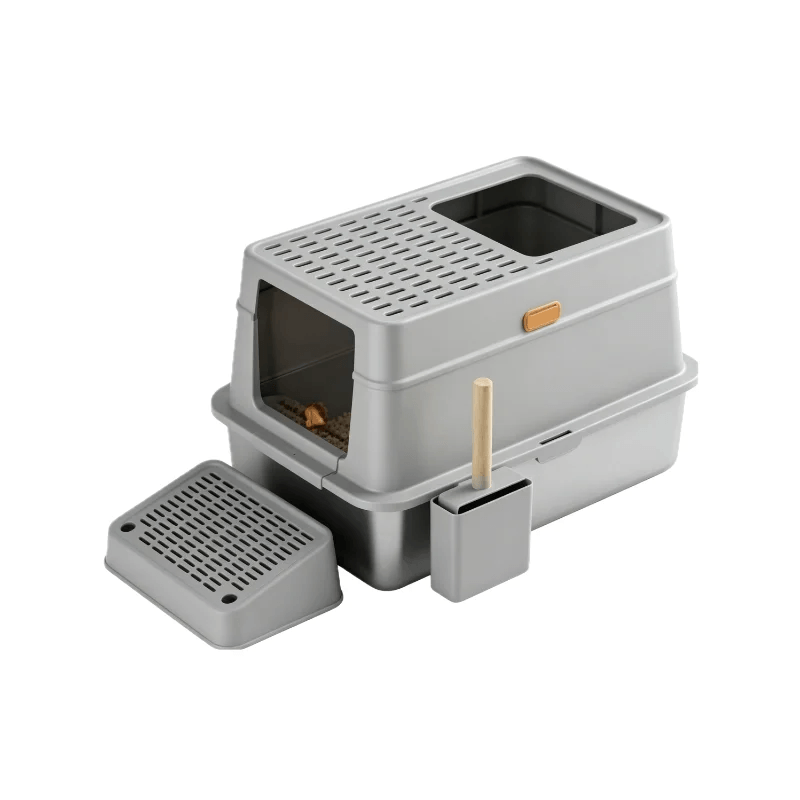
TL;DR: Most cats don’t have a strong preference between hooded and open boxes, at least according to the one peer-reviewed study anyone ever cites. Hoods work for some cats and cause real problems for others (large breeds, multi-cat homes, cats with any kind of respiratory sensitivity). What actually decides the outcome is size, ventilation, placement, and how often you scoop. The lid is almost incidental.
The One Study Everyone Cites (And What It Actually Found)
Ross et al. 2011, published in the Journal of Feline Medicine and Surgery, is the baseline every vet and behaviorist falls back on when this question comes up. Researchers tracked elimination behavior to see whether cats inherently preferred open or enclosed boxes.
The results pretty much flattened the marketing claims. Roughly 70% of the cats showed no statistically significant preference. The remaining 30% split evenly: about 15% favored covered, 15% favored open. (I’m working from memory on the exact split, so take the decimal with a grain of salt.)
The study controlled for the obvious confounders by scooping daily and using identical clumping clay in both setups. What it didn’t test is probably more interesting than what it did: multi-cat dynamics, long stretches without cleaning, or any of the large breeds that most readers of this article are probably trying to figure out.
Study at a glance:
- Focus: covered vs. uncovered preference
- Finding: ~70% no preference
- Caveat: boxes scooped daily, which eliminates the single biggest real-world variable
When a Hood Actually Helps Your Cat
Cats don’t universally want hoods, but specific households make a strong case for them. Behaviorists point out that anxious cats sometimes seek enclosed space for elimination, especially in loud or high-traffic homes.
The scenarios where I’d actually spec a hooded box:
- Litter kickers. Cats who dig like they’re tunneling to China and send a cup or two of substrate across the floor every visit. The walls and ceiling contain the blast radius.
- Shy cats in open-plan apartments without a quiet corner to work with.
- Multi-species homes where a medium-to-large dog treats the box as a snack bar. A small-entry hood blocks the dog and gives the cat an actual safe zone.
- Vertical urinators — cats who stand to pee and spray clean over the lip of a standard open pan.
That last group is more common than people think. If you’ve ever cleaned urine off the baseboard behind an open box, you know.
When a Hood Becomes a Problem
Hoods fail when they physically restrict the cat or create a hostile little chamber inside. Most commercial hooded boxes run about 22 inches long. Adult Maine Coons, Ragdolls, and Savannahs routinely hit 30 to 40 inches nose to tail tip. Shoving a 15-pound cat into a 22-inch shell forces an awkward crouch, and you end up with urine on the filter, on the inside wall, or straight out the front door.
Senior cats fail in a different way. Arthritis affects something like 90% of cats over 12. A lot of hooded designs have a 6-to-8-inch entry lip to accommodate the locking mechanism on the lid, and that step is where older cats quit. They’ll just go on the floor next to the box, which owners read as spite. It isn’t spite.
Red flag cats for hoods:
- Large breeds (Maine Coons, Ragdolls, Norwegian Forest Cats)
- Brachycephalic breeds — Persians and Himalayans have compromised airways and the trapped dust inside a hood doesn’t do them any favors
- Seniors with osteoarthritis who can’t clear the entry lip comfortably
- Asthmatic cats; feline asthma hits 1-5% of the population and a dust-saturated enclosure is a bad place to breathe
The Ammonia Question — What’s Really Trapped Inside
Hooded boxes concentrate ammonia and particulate inside because they vent through exactly one hole. Cat urinates, bacteria break urea into NH3, and that gas has nowhere to go until the cat opens the flap.
Cats have roughly 200 million olfactory receptors versus our 5 million. What reads to you as a mild “needs scooping” smell when you lift the hood is a chemical irritant to the animal who just stuck her face in it. Prolonged exposure drives respiratory irritation and, more practically for the owner, avoidance behavior.
Dust is the second half of this. Sodium bentonite (the stuff in most clumping clay) kicks up fine particulate when it’s poured and when the cat digs. In an open box that cloud disperses into the room; in a hood it hangs in the cat’s breathing zone for several minutes after she’s done burying.
| Box Type | Litter Type | Air Quality Impact |
|---|---|---|
| Open Pan | Clumping Clay | Low ammonia trapping, high room dust |
| Hooded | Clumping Clay | High ammonia trapping, high internal dust |
| Hooded | Pine Pellets | Moderate ammonia trapping, low internal dust |
| Hooded | Silica Gel | Low ammonia trapping, moderate internal dust |
I don’t have good ppm numbers to point you to. Anecdotally the difference is obvious the moment you stick your head in a hooded box that hasn’t been scooped since the day before.
How to Tell If Your Cat Dislikes Their Hooded Box
Cats almost never quit a box without warning. There’s usually a behavioral sequence first, and owners who catch it early can fix things before the carpet becomes the preferred toilet.
- Perching. Cat balances on the entry lip with her head outside the box while eliminating inside.
- Quick trips. She enters, goes immediately, bolts out, buries nothing.
- Proximity elimination. Pee or stool on the floor within a couple of feet of the box, often directly in front of the flap. The flap is almost always the culprit here.
- Roof sitting. She sits on top of the hood and refuses to go inside.
One critical distinction. If a cat is making repeated trips to the box, straining, vocalizing, or producing just drops of blood-tinged urine, that is not aversion. That’s Feline Lower Urinary Tract Disease or a urethral blockage. Blockages kill cats in 24-48 hours. Vet, now, not after you finish reading this article.
Sizing, Ventilation, and Placement That Make Hoods Work
The AAFP’s rule is that a box should be 1.5 times the length of the cat, measured nose to base of tail.
Average adult cat is about 18 inches. Run the math, you need 27 inches of box. Most hooded models on the market don’t get there. The Catit Jumbo Hooded Cat Pan is 22.4″ L x 18.3″ W x 17″ H. “Jumbo” my foot — it’s nearly 5 inches short of what an average cat actually needs. The Nature’s Miracle Advanced Hooded Corner Litter Box does better at 26″ x 26″ x 23″, but the corner-wedge footprint eats into usable floor space, so your Ragdoll is still doing geometry she shouldn’t have to do.
Placement is where I see most owners mess up with hoods specifically. Don’t put a hooded box in a dead-end closet or at the end of a narrow hallway. The hood already strips 270 degrees of peripheral vision; the cat needs a clear sightline out the front door to feel she can bail if something goes wrong. A hood plus a bad placement is just a trap with litter in it.
Transitioning a Cat To (Or Away From) a Hooded Box
Swapping an open pan for a hood overnight (or vice versa) is one of the most reliable ways I know to produce inappropriate elimination. The protocol most behaviorists use runs 7 to 14 days and relies on parallel introduction.
- Parallel placement. New hooded box next to the old open box. Do not remove the old one yet.
- Lid off. First 3-5 days, run the new box with no hood. Let her get used to the base.
- Scent transfer. Move one scoop of soiled litter from the old box into the new one so it reads as an elimination zone.
- Add the hood. Once she’s using the new base reliably, attach the hood. Pull the swinging plastic flap off entirely. Most cats hate the feel of that thing dragging across their back, and I’ve never understood why manufacturers keep including it.
- Remove the old box. After about a week of reliable use with the hood on, retire the open pan.
If she still refuses after two weeks, go back. Forcing it is how you end up with a cat who’s decided your laundry basket is the new box.
The Multi-Cat Math: Hoods in Households With 2+ Cats
The N+1 rule: one box per cat, plus one extra. Two cats, three boxes. Hoods complicate this because they change the territorial geometry of the room.
An open pan gives a cat 360 degrees of situational awareness. A hood cuts that to 90 and funnels her into a single entry and exit. In a multi-cat home that’s an ambush structure, full stop. A dominant cat can park herself three feet from the opening and the subordinate cat is now trapped mid-pee. It happens once and that box is dead to her.
If you’re going to run hoods in a multi-cat household, scatter them. Three hooded boxes lined up in the laundry room counts as one giant box in the cats’ mental map of the territory. That’s not N+1. That’s N-2 with extra steps.
FAQ
Do veterinarians recommend hooded litter boxes?
Most vets don’t take a blanket position either way. They look at the individual cat (size, age, respiratory health) and the household (how many cats, how much traffic, placement options). The 1.5x length rule and daily scooping matter more than whether there’s a lid.
Can a hooded litter box cause a UTI or other health problems?
Not directly. A hood doesn’t cause a UTI. But if your cat dislikes the box enough to hold her urine for long stretches, that concentrated urine raises the risk of Feline Idiopathic Cystitis and crystal formation, and from there you can end up in genuinely serious territory. The hood is upstream of the problem, not the cause.
Why does my cat sit on top of the hooded litter box instead of inside?
She wants to use it but something about the interior is unacceptable — usually too small, too dirty (high ammonia even if it doesn’t smell bad to you yet), or she’s worried about who might be waiting when she comes out.
How often do I need to scoop a hooded litter box compared to an open one?
Daily. No exceptions.