
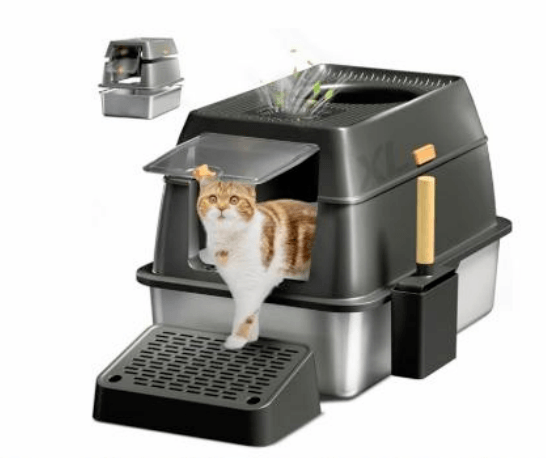
TL;DR: Get a box at least 1.5x your cat’s body length (nose to tail base), lean toward uncovered for most cats, and provide one box per cat plus one extra. Match the style to your cat’s age and mobility, not to your living room.
Start With Your Cat’s Body, Not the Box
The correct box length is 1.5 times your cat’s body from nose to tail base. For an average 10-inch cat, that’s a 15-inch box minimum. The AAFP and AAHA both put this in their guidelines as the baseline for normal elimination behavior.
Cats need room to walk in, turn around, dig, and squat without their back end hanging over the rim. Most commercial boxes on the shelf at PetSmart clock in around 18 inches, which is barely adequate for a 10-pound domestic shorthair and openly insufficient for anything bigger. A large chunk of the “why is my cat peeing on the rug” cases I see traces back to this exact problem. The box is too small, the cat feels physically pinned, and they solve the problem the way cats always do — by going somewhere else.
Veterinary Sizing Table:
| Breed/Weight Category | Cat Length (Nose to Tail Base) | Minimum Box Interior Length |
|---|---|---|
| Domestic Shorthair (~10 lbs) | 10 inches | 15 inches |
| Ragdoll (~15 lbs) | 14 inches | 21 inches |
| Maine Coon (15+ lbs) | 16 inches | 24 inches |
Measure your cat before you shop. Not after.
The Real Uncovered vs. Covered Debate
Most of the covered-vs-open debate leans on one 2013 study in the Journal of Feline Medicine and Surgery. Grigg and colleagues gave 28 cats a covered box and an open box, identical otherwise, and watched what happened. There was no statistically significant preference across the group. Roughly 80% used both about equally, four cats strictly preferred the hood, and four strictly preferred the open pan.
The caveat everyone skips: both boxes were scooped every day. That matters, because covered boxes are essentially ammonia traps. Miss a scoop and the concentration inside the hood spikes fast. A 2019 veterinary assessment flagged ammonia above 25 ppm as a high-stress threshold for cats, and it doesn’t take long to hit that inside a sealed dome with fresh urine sitting in clay.
So the honest answer is: covered boxes are fine if you’re the kind of person who actually scoops daily. If you’re not, you’re punishing your cat for your schedule.
When a covered box actually is the right call:
- High-kicking excavators. Cats that treat the box like a construction site.
- Dog households where the dog raids the box. You know why.
- High-anxiety cats that visibly prefer den-like enclosures for everything, not just eliminating.
Multi-Cat Math — Beyond the N+1 Rule
For two cats you need three boxes. This is the N+1 rule and it comes out of the Ohio State Indoor Pet Initiative’s work, and it’s non-negotiable for households with any history of conflict.
The catch is that N+1 only works if the boxes are actually separated. Three boxes lined up against the laundry room wall is one giant box in the cat’s head. A dominant cat can guard that whole room from one doorway without moving.
Distribute across sightlines and floors. In a two-story house with two cats, one box upstairs, one downstairs, one somewhere neutral. The key is that a subordinate cat should always have a route to a box that doesn’t require passing the other cat in a hallway. Ambush points near box exits are one of the fastest ways to create permanent aversion, and once it’s set in, undoing it takes months.
Sizing Up for Large Breeds (Maine Coon, Ragdoll, Savannah)
Standard boxes fail cats over 12 pounds. A 16-inch Maine Coon needs a 24-inch box just to turn around, and pet stores basically don’t stock anything that big. Which is why the storage tote hack has been the standard workaround for large-breed owners for years.
An 18-gallon Sterilite bin, or the 60-gallon version if you have a truly huge cat, with a U-shaped opening cut in the front, gives you a massive high-sided box for under $20. The high sides catch urine spray and kicked litter, which is where most commercial jumbo boxes fall down. Sand the cut edge so it doesn’t snag paws.
If you want something that looks less like a bin from your garage, there are commercial options:
| Product Model | Interior Dimensions | Entry Style | Retail Price |
|---|---|---|---|
| Modkat XL | 21″ L x 16.5″ W x 17″ H | Front / Top Hybrid | ~$99 |
| IRIS Jumbo Top Entry | 20.5″ L x 16.1″ W x 14.5″ H | Top Entry | ~$40 |
| iPrimio XL Stainless | 23.5″ L x 15.5″ W x 6″ H | Open Pan | ~$88 |
The Modkat XL gets the aesthetic press but the IRIS Jumbo at forty bucks does most of the same job. And obviously you wouldn’t put a Ragdoll in a top-entry if the cat has any hind-end weakness at all.
Senior, Arthritic, and Special-Needs Cats
Around 90% of cats over 12 have some degree of osteoarthritis. Most owners never realize it because cats hide pain in the specific ways cats hide pain, which mostly means “stopping doing things.” Stepping over a 6-inch litter box rim is one of those things. They won’t cry. They’ll just start peeing next to the box on the bath mat, and you’ll blame the litter, or the box, or the cat.
For geriatric cats you want an entry threshold under 4 inches. The Lucky Champ pan has a dipped 3.5-inch front entry with higher back walls to catch missed spray, which is the profile you’re looking for. Some people cut down a storage tote instead — same idea, cheaper.
Declawed cats are a separate problem entirely. Amputating the last toe bone leaves paws chronically sensitive, and coarser substrates like pine pellets or hard clay can genuinely hurt them. Switch to fine unscented clumping clay, no more than 1 to 2 inches deep. I still recommend clay-only for declawed cats even though the environmental argument for pine and wheat and corn is real. Old habit, not fully justified — I’ve just seen too many declawed cats reject alternatives and I stop experimenting once I know something works.
Material Matters — Plastic, Stainless Steel, and Why Your Box Has an Expiration Date
Plastic boxes need replacing every 6 to 12 months. Every time a cat digs, their claws score microscopic grooves in the plastic. Those grooves absorb ammonia. Over months you build up a saturated layer that scrubbing cannot reach.
The diagnostic is odor rebound. If you deep-clean a plastic box, scrub it top to bottom with dish soap and let it dry, and it smells like urine again within 24 to 48 hours — that plastic is done. Throw it out. No amount of enzyme cleaner reverses it.
Stainless steel doesn’t have this problem. The iPrimio XL Stainless (23.5″ long, around $88) is the one most people end up with. Non-porous, non-scratching, wipes clean. It looks like a hotel-kitchen tray and some cats find it slippery underfoot at first, but they adjust in a week.
Cost per year comparison:
- Plastic tray at $25, replaced annually, over 5 years = $125
- Stainless steel pan at $88, replaced never = $88
That math ignores the smell, the landfill, and the recurring hassle of finding a box the right size when your usual model gets discontinued. Which happens more often than you’d expect.
Are Self-Cleaning Litter Boxes Worth the $300-$700?
Smart boxes like the $699 Whisker Litter-Robot 4 cut daily scooping, but they’re appliances, not magic. They fail in predictable ways.
Common Litter-Robot 4 issues in the wild: optical sensors get coated in litter dust and trigger a solid-red “Cat Sensor Fault” that halts cycling. In humid environments, clumping litter sticks to the rubber globe liner and you end up scraping it off manually, which defeats most of the point. Weight sensors go out of calibration.
Safety is the more important question. Whisker and PetSafe both include weight sensors and pinch-protection that abort the motor if a cat is inside. The cheap unbranded units flooding Amazon frequently don’t. That’s an entrapment hazard, not a minor one, and it’s the reason I tell people to buy brand-name or don’t buy at all.
Verdict:
- Buy if: you work 12-hour shifts, you’re pregnant (toxoplasmosis), or scooping is physically difficult for you.
- Skip if: your cat is under 3 pounds (weight sensor won’t trigger reliably), your cat is arthritic and finds the entry step hard, or you’re expecting zero maintenance.
Placement — The Under-Discussed Deal-Breaker
Cats won’t eliminate near food and water. This is old-brain wiring, not preference. Bowls and boxes should be at least 3 to 5 feet apart, ideally in separate rooms.
Five placement mistakes that create aversion:
- Next to a washing machine or furnace that kicks on unpredictably.
- In a dead-end closet with no line-of-sight escape.
- All boxes upstairs when the cat lives downstairs.
- Near the dog’s bed.
- Wedged next to a toilet in a high-traffic bathroom.
Setup Checklist — First 30 Days With a New Box
Litter depth matters more than people think: 2 to 3 inches. Deeper and the cat feels unstable digging. Shallower and urine hits the plastic directly, which starts the odor-rebound clock immediately.
30-Day Monitoring Checklist:
- Week 1: Don’t remove the old box. Set the new box next to it. Low-stakes transition.
- Week 2: Drop the old box’s litter to 1 inch, bring the new box up to 3 inches. Cats generally prefer the deeper, fresher option.
- Week 3: After 3 consecutive days of exclusive new-box usage, remove the old one.
- Week 4: Watch the rim. If your cat is balancing on the edges rather than standing inside, either the box is too small or the litter is too dirty. Sometimes both.
FAQs
How many litter boxes do I need for 2 cats?
Three. One per cat, plus one extra. Put them in different rooms.
What size litter box is best for a large cat?
A Maine Coon or similarly-sized breed needs a box at least 24 inches long. Standard 18-inch boxes don’t work. The common solution is an 18-gallon plastic storage bin with a U-shape cut into the front, which runs you under $20 and outperforms most commercial jumbo boxes because the sides are taller. Sand the cut edge. Watch the first few uses to make sure your cat is stepping in cleanly rather than clipping a paw on the opening. If your cat has any mobility issues, cut a lower entry or reconsider a bin entirely.
Are covered litter boxes bad for cats?
The 2013 Grigg study showed no group-level aversion — as long as boxes get scooped daily. If they don’t, ammonia builds up inside the hood fast and cats will refuse.
How often should I replace my cat’s litter box?
Plastic: every 6 to 12 months. Claws carve grooves that trap odor permanently. Stainless steel: essentially never.
Where should I NOT put a litter box?
Within 3 feet of food or water, next to noisy appliances, or in dead-end spaces with no escape route.